Priced from the job.
Not the quoter.
Anyone in your office can price a job the way your best quoter would — the same answer on a Monday, on a Friday, and from someone who started last week. Volume, distance and access, computed to the cent, with every hour showing.
Then it runs the job it priced — quote, schedule, crew, payment and review, on one record.
One month free. Every job, every quote, no card.
Month to month. No contract, no setup fee. Leave any month and take your data with you.
Check a job you've quoted in the United States
The job you quoted
You've been pricing the same job differently for years.
A third-floor walk-up in Chicago's Lincoln Park moving up I-94 to Milwaukee: a box truck, a crew of three, no elevator, and a parking permit to hold the curb on a busy street. Cerrax prices it from the cube in cubic feet, the interstate miles and the time three flights of stairs add — the crew's hours line by line.
Same job. Three prices. None of them wrong — and none of them right.
Not because it is the right number for your firm — it is worked out from reference rates, and yours will differ. Because it is the same number every time, and you can see every hour behind it. Try it on a job of your own, above.
And when a job overruns — when the crew takes two hours longer than the quote allowed — you don't know why. Was the volume wrong? The stairs? The parking? Did the customer add a piano you didn't know about? The money's gone either way, and the next quote will be just as uncertain.
Cerrax computes it. Same logic, every time. When a job overruns, you find out which part of the price to look at.
Then it runs the job it priced.
One record from the first inquiry to the review — not a price you copy into something else.
Inquiry
From your website or a lead site, straight into your inbox — already captured.
Quote
Priced from the job, sent as a page the customer opens and accepts.
Booked
Into the schedule, with the crew and trucks it needs. Over-booked days show.
The day
The crew have it on their phones: on the way, arrived, damage photos, a signature.
Paid
Deposit when they accept, balance by card link when the job is done.
Review
Every customer asked, three days after the move, with your Google link.
Three things that drive the price.
Volume, distance, and access conditions. Computed consistently, from the job — not from memory.
Volume
How much to move
Room by room, or direct cubic feet. 231 item types tracked. The volume drives load time, crew size, and truck configuration.
Distance
How far to go
ZIP code to ZIP code, exact. Not a rough estimate. Distance drives transit time and mileage cost — precision here matters.
Conditions
What the job involves
Stairs, parking difficulty, long carry, furniture to dismantle. Each has your own rate — a long carry can be banded by the foot — and the time it adds shows in the day's plan.
Your rates, your margin, your call — you can override any price, and the override is kept, not swallowed. The engine does the arithmetic; it never takes the wheel.
And then it runs the job it priced.
The price is the part nobody else computes. It is not the part you spend your week in. Every inquiry, quote, booking, schedule day and crew sheet lives on the same record as the price that started it — so nothing is retyped, and nothing is lost between the quote and the truck.
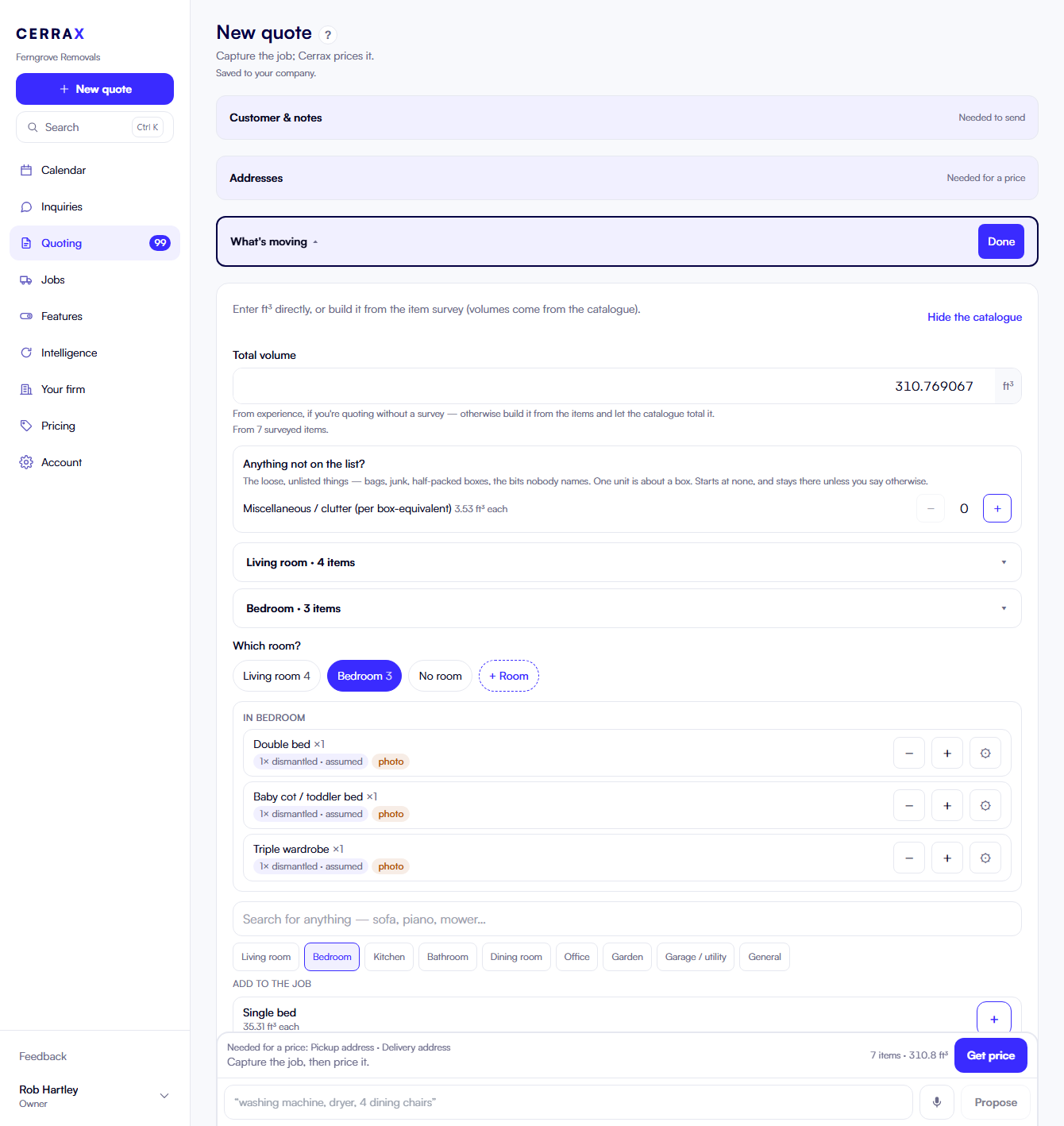
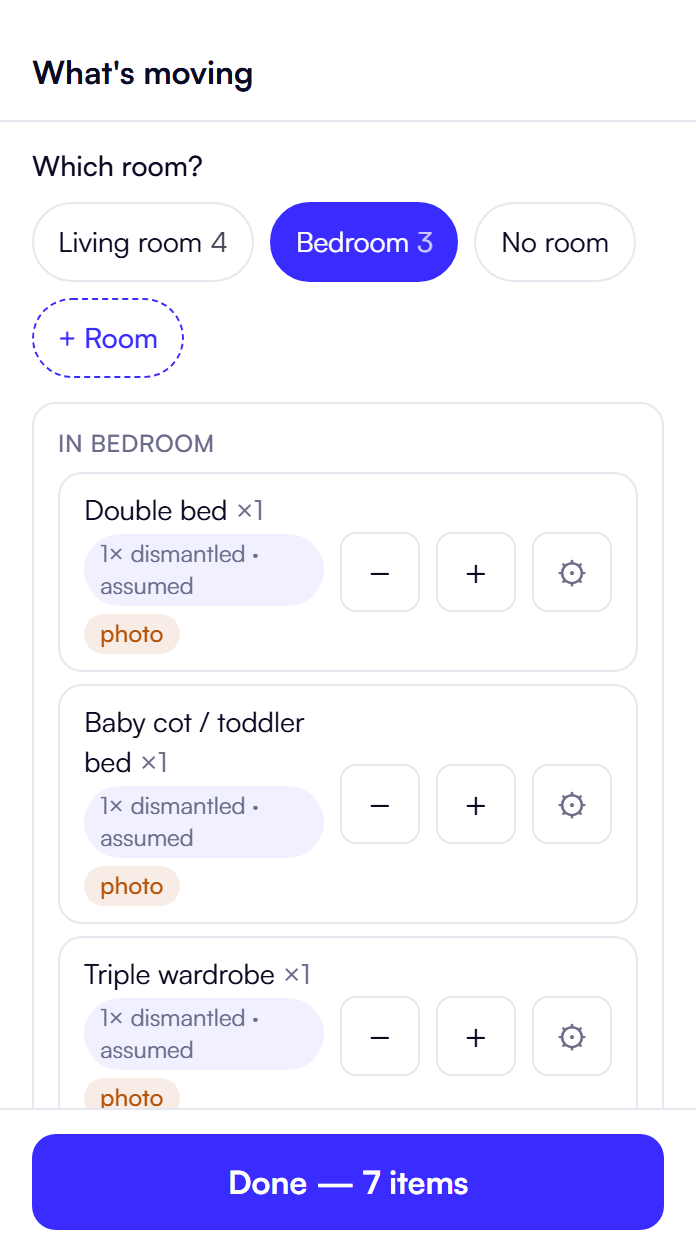
The same week, run two ways.
Survey the job, then a spreadsheet, then a number you argue yourself into.
Survey the job. The price is the next screen.
The number depends on who quoted it, and what kind of day they were having.
The number comes from the volume, the distance and the access. Every time.
A customer asks why it costs that, and the honest answer is experience.
Every line traces to an hour, and every hour to a fact about the job.
A job overruns. You feel it in the month, and never find out which part was wrong.
You record what actually happened. The engine says which rate was off and proposes the correction.
An inquiry comes in through the website and becomes a callback in two days.
A price on your own page in two minutes, and the job is already captured.
“AI quoting” that can’t tell you, or your customer, where the number came from.
AI suggests the items from what you say or a photo of your list. You confirm them. The price is never the AI’s — every line shows its working.
Let them film it. You still price the job.
Your customer can add a video of their home from the quote page, or from a “film your home” link you send them. It plays beside your survey, so you can walk the house without driving to it.
You confirm the items as you watch, and each one is marked with the moment it was seen — so if a wardrobe is disputed later, you can point to the second it was on screen.
- The video is evidence, not a guess. Nothing in it becomes a price until you have confirmed what is there.
- The price still comes from the job. Volume, distance and access — worked out the same way it would be after a visit.
- It's on for every firm. Switch it off in one place if you would rather not ask.
What changes when the price comes from the job.
You can hand the quoting to someone else.
The logic lives in the system, not in one person's head. Train a new quoter in an afternoon.
The price doesn't change when you're on vacation.
Nothing gets left out of the price.
Crew time, mileage and access are priced the same way on every job — from the job, not from memory. When a job overruns, you can see which figure was off and change it.
You can quote without padding.
When every figure is worked out from the job, there's less to cover with a cushion — and padding loses the jobs it was meant to protect.
It runs in a browser — phone, tablet or laptop, nothing to install and no app store. Add it to your home screen and it opens like an app.
One engine. Three ways to use it.
Whether you quote jobs, run a website, or build the software that does — the price comes from the job, not the quoter.
No CRM? Run your quoting — and the job — on Cerrax.
Capture the job, price it, send the quote, then book it, put the crew on it and get paid. Nothing to wire up.
See the productNo website? We'll build you one that prices.
A page of your own with a working quote form on it — or the same form on the site you already have. Your branding, your rates, a deposit when they accept and the balance after.
See what you'd getBuild moving software? License the engine.
Deterministic, explainable, auditable pricing behind your own workflow. We price; you keep everything else.
For platforms →The pricing gets better with every job.
When a job takes longer than quoted, you record it. Cerrax identifies which rate was off — load time, access, distance — and proposes a correction. You approve it. The next quote is more accurate.
Until about twenty finished jobs are in, prices come from reference rates and your own settings — and every quote says so. After that, they are tuned to your firm.
Not from industry averages. From your crew, your routes, your reality.
Your experience sets the rates. The engine just applies them the same way every time.
Calibration means tuning the engine to your real costs — your crew speeds, your routes, your overheads. You keep that work, whatever you decide.
Same job, same price — this year, next year, to the cent.
Every quote is replayable: the price can be reproduced from its inputs, exactly, at any time. That's not a promise, it's how the engine is built.
See the proofA few things worth knowing first.
- Is tax included in the price?
- Here is how it works in this market. Prices are in US dollars and before any sales tax. Cerrax is not registered to collect sales tax in any US state today, so none is added to your bill; if we register in a state where our service is taxable, we will add that state's tax at checkout as a separate line and tell you first.
- Do I need a card to start?
- No. You can price your first job in minutes without one. A card is asked for later, only so that choosing a plan is quick. Adding it takes nothing from you, and the payment provider holds it: Cerrax never sees the card.
- Can I cancel any month, and how?
- Yes. Cerrax is month to month, with no contract, no setup fee and no minimum term. The account owner opens Settings, then Billing, then Manage subscription, which opens the payment provider's own page: cancel there, change plan, update a card or read an invoice. Nobody has to email us. On the free trial, a plan you chose to start when your free month ends is not on that page: cancel it on Cerrax's own Subscription page (Settings, then Billing), with the Cancel button beside it. If you have not added a card, there is nothing to cancel.
- What if Cerrax's price for a job is wrong?
- Then you change it. You can override any price, and the override is kept rather than lost. Every price comes with the reasons behind it, so you can see what moved it. Once you have recorded around twenty finished jobs, Cerrax starts proposing corrections to how long your jobs take, and you approve each one before it changes anything.
Cerrax in the United States
- Currency
- USD
- Consumption tax
- Sales tax (state)
- Distance quoted in
- miles
- Legal system
- US federal + state
- Data protection
- State patchwork (CCPA et al.)
- Availability
- Open — firms can sign up and are served today.
What an American estimate carries
There is no national sales tax: each state decides whether a move is taxed — most leave transportation untaxed, a few tax services broadly — so the firm declares its own state's rule and the estimate is written before tax. An interstate mover prints its USDOT and MC numbers on the estimate, and the truck runs under FMCSA hours of service — 11 hours driving inside a 14-hour window after 10 hours off — which is what decides how far a Chicago-to-Denver load gets each day. Distances are in miles, the load in cubic feet, and the trade association is the Moving & Storage Conference of the American Trucking Associations.
The vehicles it plans with here:
- Cargo van (246 cu ft)
- 15-ft box truck (764 cu ft)
- 20-ft box truck (1,016 cu ft)
- 26-ft box truck (1,682 cu ft)
- Can I use Cerrax in the United States today?
- Open — firms can sign up and are served today.
- How are moving jobs priced in the United States?
- Jobs here are priced on volume, which is the basis Cerrax computes from. Confirmed against local practice. A mover here quotes a local move by the hour and crew, and a long-distance move from an itemized survey of the goods — the estimator's cube sheet, item by item in cubic feet, which is the basis Cerrax computes from. Federal rules for moves between states (49 CFR Part 375) require a written estimate that says whether it is binding, a physical or virtual survey unless waived in writing, and a valuation choice; each state regulates moves within it.
Put a month of jobs through it.
Price your first job in minutes — no card, no contract. One month free, and nothing you made is taken away at the end.
Start free →Would rather we did it? Book a 20-minute call and bring a few recent jobs — we'll price them live.